5380 KING JAMES WAY SUITE A1, FITCHBURG, WISCONSIN 53719




STRENGTH TRAINING BLOG
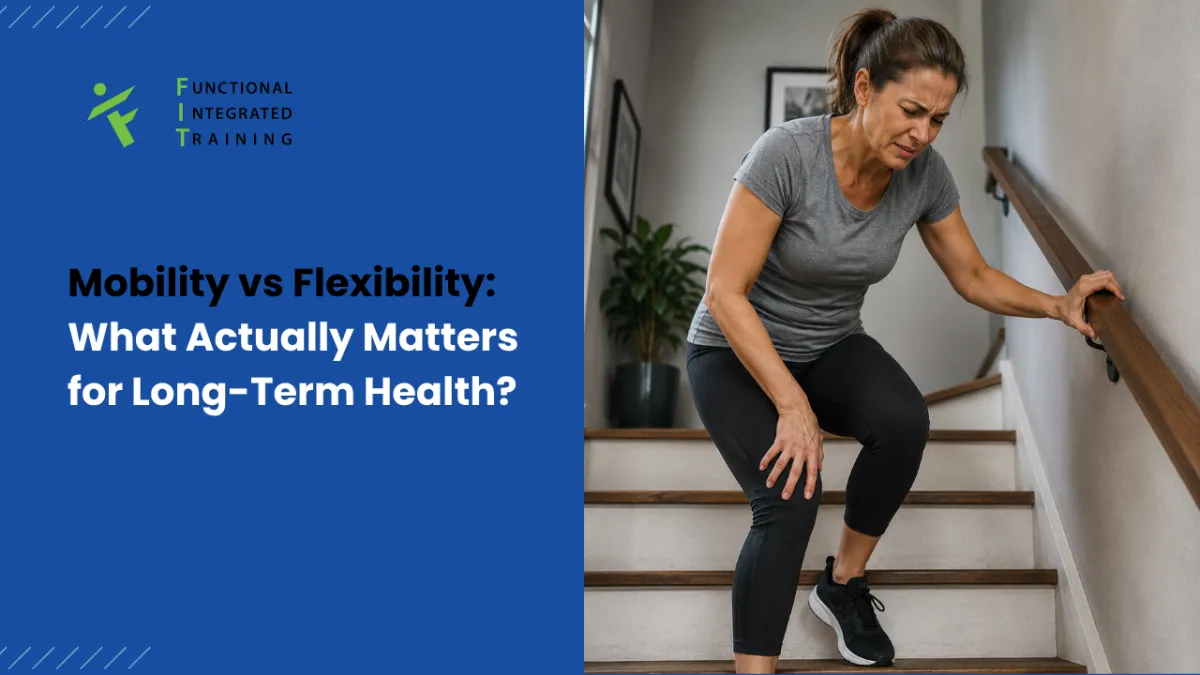
Mobility vs Flexibility: What Actually Matters for Long-Term Health?
Most people use "mobility" and "flexibility" like they mean the same thing. They don't.
You might be flexible enough to touch your toes but still feel stiff when climbing stairs or reaching overhead. That's not a flexibility problem, that's a mobility problem.
And here's the thing: if you're training for long-term health, athletic performance, or just the ability to move well into your 40s, 50s, and beyond, knowing the difference isn't just interesting. It's essential.
In this article, we'll break down what mobility and flexibility actually mean, why most fitness programs get this wrong, and how a functional training approach addresses both, so your body works the way it's supposed to, for life.
Want to move better and feel stronger for the long run?
Start a functional training program built around your body's real movement needs, not just aesthetics.
First, Let's Clear Up the Confusion
The words mobility and flexibility get mixed up all the time in gym conversations, fitness apps, and even some training programs. But they describe very different things.
Flexibility: Passive Range of Motion
Flexibility refers to how far a muscle can be stretched usually passively, meaning with help from gravity, a prop, or an external force.
A classic example: lying on your back and pulling your leg toward your chest to stretch your hamstring. Your hamstring may reach a certain length that's your flexibility.
Flexibility is:
A passive quality
Muscle-length dependent
Largely about tissue extensibility
Measured by how far you can stretch with external assistance
Mobility: Active Control Through Range of Motion
Mobility is your ability to actively move a joint through its full range with control, strength, and stability.
Using the same example: can you actively raise your leg to that same height without pulling it? That's mobility.
Mobility includes:
Joint range of motion
Muscular strength through that range
Neuromuscular control
Stability and coordination
The ability to express flexibility under load or movement
The Key Difference: Passive vs Active
Think of it this way:
Flexibility = the range that exists
Mobility = the range you can USE
You can be extremely flexible without having good mobility. A person with naturally loose ligaments might fold into a deep stretch but struggle to perform a controlled squat or lunge. Their range exists but they can't access it meaningfully in movement.
This distinction matters enormously for long-term health.
Why Flexibility Alone Isn't Enough
For decades, stretching was marketed as the foundation of a healthy body. Touch your toes, hold for 30 seconds, repeat. That's it.
But flexibility without strength and control through that range can actually increase injury risk. Hypermobile joints joints that move too far without muscular support are vulnerable to sprains, strains, and chronic pain.
Real-world movement doesn't happen in a static stretch. It happens:
When you reach down to lift something off the floor
When you twist to look behind you while reversing a car
When you step off a curb and your ankle has to respond
When you carry groceries up a flight of stairs
None of those situations care how far you can stretch in a yoga pose. They all require mobility active, controlled, purposeful movement.
What Actually Matters for Long-Term Health?
When it comes to ageing well and staying physically capable, the research consistently points to a few key factors:
1. Joint Health and Range of Motion
Healthy joints require regular movement through their full range. When we stop using a joint's full capacity through sedentary habits, repetitive movements, or poor posture we lose it. Cartilage thins, synovial fluid decreases, and mobility declines.
Mobility work keeps joints healthy, lubricated, and capable over time.
2. Strength Through Range of Motion
Stretching a muscle is one thing. Being strong through that stretched position is another. Functional training builds strength in the ranges you actually us not just at the midpoint of a movement.
This is what protects your lower back when you bend, your knees when you descend stairs, your shoulders when you reach overhead.
3. Balance and Stability
Falls are one of the leading causes of serious injury in adults over 50. Balance and stability training which is central to functional mobility work significantly reduces fall risk and improves quality of life.
4. Movement Pattern Quality
How you squat, hinge, push, pull, and rotate matters more than how flexible your individual muscles are. Poor patterns lead to compensations and compensations lead to injuries over time.
Functional training is built around correcting and optimising these patterns.
Ready to build real, usable strength at any age?
Book a consultation at Functional Integrated Training and discover a personalised approach to mobility and strength that works for your body.
How Functional Training Addresses Both Mobility and Flexibility
Functional training doesn't separate mobility from strength it integrates them. Every exercise is designed to build usable, active range of motion while strengthening the body through real-world movement patterns.
1. Dynamic Warm-Ups Instead of Static Stretching
Static stretching before a workout has been shown to reduce power and performance. Functional training uses dynamic warm-ups leg swings, hip circles, thoracic rotations that take joints through active range of motion, preparing the body to move.
2. Multi-Planar Movements
Traditional gym machines move in one plane. Real life doesn't. Functional training includes movements in all planes sagittal (forward/backward), frontal (side to side), and transverse (rotational) building mobility and strength in all directions.
3. Compound Exercises That Load the Full Range
Exercises like goblet squats, Romanian deadlifts, and single-leg movements require the body to move through deep ranges under load. This builds both flexibility (tissue extensibility) and mobility (controlled strength through that range) simultaneously.
4. Targeted Mobility Drills
Specific mobility drills for hips, thoracic spine, ankles, shoulders are woven into functional training programs. These aren't just stretches; they're active exercises that build both range and control.
5. Core Stability as the Foundation
Mobility without a stable core is like having powerful steering on a car with no chassis. Core stability allows you to express mobility safely and efficiently and functional training places it at the centre of every session.
Sample Mobility-Focused Functional Training Session
Here's a session designed to build active mobility while developing functional strength:
Warm-Up (10 minutes)
Hip circles 10 each direction
Leg swings (front/back and side to side) 10 each
Thoracic rotations in a deep squat hold 8 each side
Ankle mobility drills 10 each
Main Session
Goblet Squats 4 sets x 6 reps (deep range, controlled)
Single-Leg Romanian Deadlifts 3 sets x 6 reps each side
Lateral Lunges 3 sets x 8 reps each side
Kettlebell Windmills 3 sets x 5 reps each side
Pull-Ups or Assisted Pull-Ups 3 sets x 6 reps
Cool-Down / Mobility Finisher (10 minutes)
90/90 Hip Stretch 2 minutes each side
Couch Stretch (hip flexors) 90 seconds each side
Cat-Cow 2 x 10
Child's Pose with lateral reach 60 seconds each side
This session addresses both flexibility (through full range loading and cool-down work) and mobility (through active, controlled movement throughout).
Who Benefits Most from This Approach?
Prioritising mobility over static flexibility benefits virtually everyone but it's especially impactful for:
Adults over 30 noticing increasing stiffness
Office workers with tight hips, rounded shoulders, and weak core
Athletes wanting to improve performance and reduce injury risk
Anyone recovering from chronic pain or movement-related injuries
People who want to stay physically active well into their later years
At Functional Integrated Training, this model forms the basis of how clients are trained with mobility built into every session, not bolted on as an afterthought.
Common Mistakes People Make With Mobility and Flexibility
Relying only on yoga or static stretching and calling it "mobility work"
Skipping warm-up and jumping straight into heavy lifts
Working through a limited range due to discomfort and never addressing the root cause
Training only the muscles they can see (chest, arms) while ignoring hips, thoracic spine, and ankles
Confusing soreness with tightness not everything needs stretching; some areas need strengthening
Final Thoughts
Flexibility and mobility are not the same and understanding the difference could be one of the most important shifts you make in how you approach your health and fitness.
Flexibility tells you how far your tissue can go. Mobility tells you how well you can actually use that range with strength, control, and confidence.
For long-term health, what matters is not just reaching your toes it's being able to squat down to pick something up at 65. It's having the shoulder mobility to carry your luggage. It's moving through life without restriction, pain, or fear of injury.
The shift is simple: stop training for the mirror. Start training for movement.
Take the first step toward moving better, for life.
Book a session at Functional Integrated Training and let's build a body that moves the way it was designed to.
FAQs
1. Is mobility more important than flexibility?
For long-term health and functional performance, yes. Mobility which includes active control through a range of motion is more applicable to real-world movement than passive flexibility alone.
2. Can I improve mobility without a gym?
Yes. Many effective mobility drills require no equipment bodyweight squats, hip hinges, thoracic rotations, and ankle circles can all be done at home. However, guided programming from a professional ensures you're addressing the right areas effectively.
3. How often should I work on mobility?
Ideally, mobility work should feature in every training session even if just 10 minutes of dynamic warm-up and cool-down. Dedicated mobility sessions 2–3 times per week can accelerate results significantly.
4. Does age affect mobility more than flexibility?
Age affects both, but the decline in active mobility is often more impactful on quality of life. The good news is that mobility responds well to training at any age it's never too late to improve.
5. Is functional training suitable for people with joint pain?
In many cases, yes but it depends on the cause. Functional training can help address movement imbalances that contribute to joint pain. Always consult a qualified trainer who can assess and adapt the programme to your specific needs.

5380 KING JAMES WAY SUITE A1, FITCHBURG, WISCONSIN 53719
And Serving Madison, Verona, Middleton, and surrounding areas.


