5380 KING JAMES WAY SUITE A1, FITCHBURG, WISCONSIN 53719




STRENGTH TRAINING BLOG
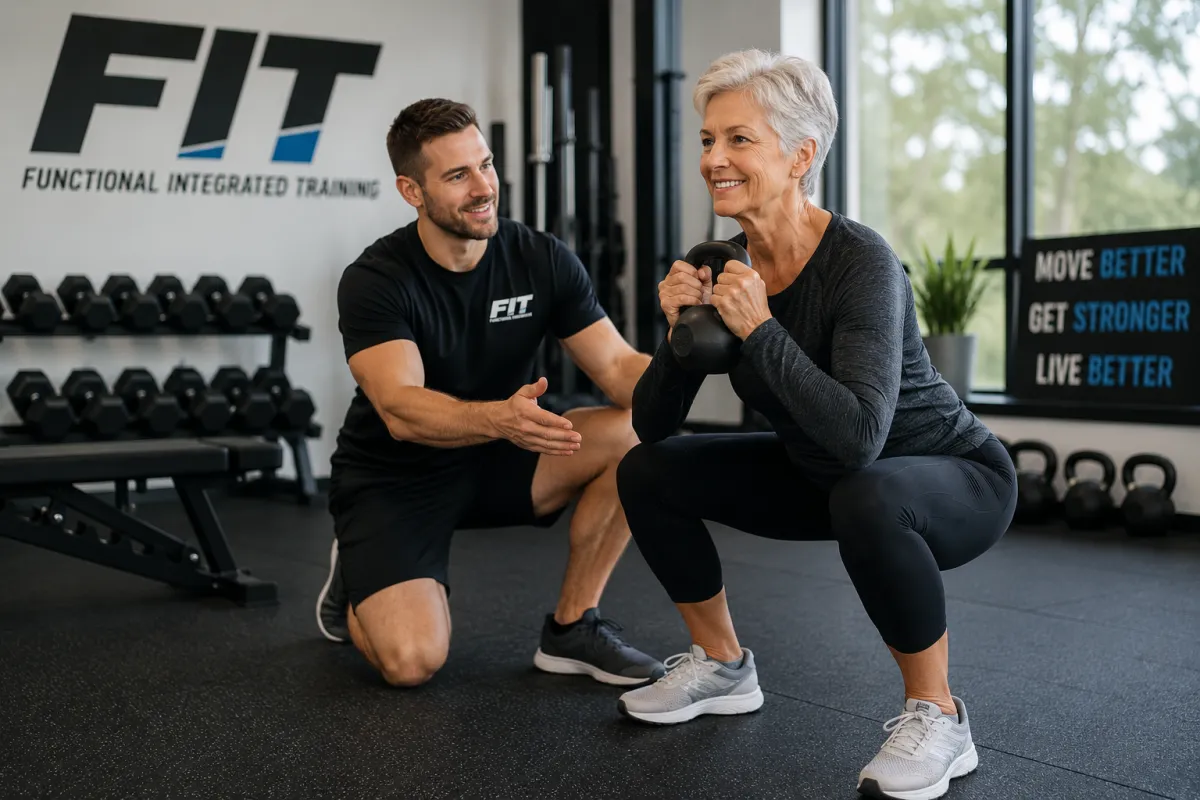
How to Stay Strong and Injury-Free as You Age in Fitchburg
Getting older does not mean slowing down. But it does mean your body needs a smarter approach to training. The habits that worked in your 20s may not serve you as well in your 40s, 50s, and beyond, and ignoring that reality is one of the fastest ways to end up sidelined with a preventable injury.
At Functional Integrated Training in Fitchburg, we work with adults at every stage of life who want to stay active, capable, and pain-free for the long haul. This guide breaks down exactly what it takes to build lasting strength without breaking down.
Why Injury Risk Increases with Age
As you get older, a few key physical changes make you more vulnerable to injury if your training does not adapt:
Muscle mass declines gradually, reducing the support around joints
Connective tissue becomes less elastic, making tendons and ligaments slower to warm up
Recovery time increases, so training too hard too often accumulates damage faster than it can be repaired
Balance and proprioception (your body's sense of where it is in space) can decline without consistent training
None of this is inevitable, but it does require intentional effort. The good news is that the right training approach addresses all of these factors at once.
The Pillars of Staying Strong and Injury-Free as You Age
1. Prioritize Functional Strength Over Isolated Movements
Injury prevention starts with building strength in the patterns your body actually uses every day: squatting, hinging, pushing, pulling, carrying, and rotating. These compound movements strengthen not just muscles, but the stabilizing structures around your joints.
Our personal training program in Fitchburg is built around these foundational movement patterns, customized to where you are right now and where you want to go.
2. Build Mobility Alongside Strength
Strength without mobility creates stiff, restricted movement that leads to compensations and eventual breakdown. If you cannot move through a full range of motion, you will recruit muscles and joints that were not designed to handle that load.
Joint mobility work, particularly for the hips, shoulders, thoracic spine, and ankles, should be a regular part of every training week, not an afterthought. When you move well, you also lift more safely and efficiently.
3. Train Consistently, Not Heroically
One of the most common injury patterns we see in adults over 40 is the cycle of going too hard after a stretch of inactivity. The weekend warrior approach, doing nothing Monday through Friday and then going all-out on the weekend, puts enormous stress on undertrained tissue.
Consistent moderate-effort training builds resilience over time. Your tendons, ligaments, and cartilage adapt much more slowly than your muscles, and they need steady progressive load to stay healthy. Three to four well-structured sessions per week beats two brutal ones every time.
Our small group training classes make that consistency easier to maintain, with expert coaching and a supportive community keeping you accountable.
4. Respect Warm-Up and Cool-Down
As connective tissue becomes less pliable with age, skipping a proper warm-up is a much bigger risk than it was at 25. A 10-to-15-minute warm-up that gradually raises your heart rate and moves your joints through controlled ranges primes your body to perform safely.
Cooling down matters too. Gentle movement after training helps clear metabolic byproducts and reduces next-day soreness, which can otherwise discourage you from training consistently.
5. Give Recovery the Attention It Deserves
Recovery is not laziness. It is where adaptation happens. As you age, your body takes longer to repair and rebuild between sessions, which means:
Sleep quality becomes a non-negotiable training variable
Nutrition, especially adequate protein intake, is essential to maintaining muscle
Rest days need to be respected, not seen as lost progress
Active recovery, such as walking, light stretching, or low-impact movement on off days, helps maintain blood flow to recovering tissues without adding excessive stress.
6. Work with Coaches Who Understand Aging Bodies
Cookie-cutter programs designed for 25-year-olds will not serve you well at 45 or 55. Working with experienced coaches who understand how to modify intensity, volume, and exercise selection based on your age, history, and current condition is one of the most valuable things you can do for your long-term health.
At FIT, every client starts with a free personal evaluation where we assess how you move, identify any limitations or areas of concern, and build a plan that meets you where you are.
Ready to Train Smarter in Fitchburg?
Whether you are just getting back into exercise or looking to stay ahead of the aging process, FIT's expert coaches are here to build a program that keeps you strong, mobile, and injury-free for years to come.
Schedule your free fitness assessment at Functional Integrated Training today. Call us at (608) 602-8689 or visit functionalintegratedtraining.com.
Common Mistakes That Lead to Injury in Adults Over 40
Knowing what to do is important. Knowing what to avoid is equally so. These are the patterns we see most often that lead to setbacks:
Skipping the warm-up because you feel fine
Adding too much weight too quickly
Ignoring pain signals and pushing through them
Doing the same workout repeatedly without variation or progression
Focusing only on aesthetics and neglecting movement quality
Training without any guidance on form or technique
Most injuries in adults over 40 are not random bad luck. They are the result of accumulated stress on undertrained or under-recovered tissue. The fix is not to train less. It is to train better.
What Smart Aging Looks Like at FIT
The members of our Fitchburg community who stay consistently strong and injury-free share a few traits:
They show up regularly, not sporadically
They communicate openly with their coaches about how they feel
They take rest and recovery as seriously as their training sessions
They progress gradually and celebrate consistent improvement over time
That approach works at any age, and it compounds. Five years of consistent, intelligent training produces results that no crash program can match.
Take the First Step Toward Injury-Free Training
Our team at Functional Integrated Training in Fitchburg works with adults of all ages and fitness levels. We will assess where you are, design a program around your goals, and coach you every step of the way.
Book your free discovery call or visit us at 5380 King James Way, Suite A1, Fitchburg, WI 53719.
Frequently Asked Questions
Is it safe to start strength training if I have never done it before and I am over 50?
Yes, absolutely. Starting strength training in your 50s, 60s, or even later is not only safe with proper guidance, it is one of the best things you can do for your long-term health. The key is starting with an appropriate assessment, using correct form, and progressing at a pace that matches where you are. Our coaches at FIT specialize in exactly this.
How many days a week should I train to stay injury-free as I get older?
Three to four structured sessions per week is a strong target for most adults. That frequency allows for consistent adaptation while giving your body adequate recovery time between sessions. The sessions do not need to be long, but they do need to be intentional and well-designed.
What is the difference between soreness and an injury?
Delayed onset muscle soreness (DOMS) typically shows up one to two days after a workout and feels like a dull ache in the trained muscles. It resolves within a few days and is a normal part of adaptation. An injury, by contrast, tends to involve sharp or stabbing pain, pain that worsens during movement, swelling, or pain that does not improve with rest. If something feels wrong beyond normal soreness, stop training that area and consult a professional.
Do I need a personal trainer or can I do this on my own?
You can make progress on your own, but having a coach significantly reduces your injury risk and accelerates your results. A coach corrects form in real time, adjusts your program as your body changes, and helps you avoid the overtraining patterns that lead to most preventable injuries. For adults over 40 especially, that guidance is worth a great deal.
Does Functional Integrated Training offer programs for older adults in Fitchburg?
Yes. FIT serves adults of all ages and fitness levels in the Fitchburg and greater Madison area. Our personal training, small group coaching, and fitness assessment programs are all designed to be adapted to your specific needs, history, and goals. You can learn more at functionalintegratedtraining.com or call us at (608) 602-8689.

5380 KING JAMES WAY SUITE A1, FITCHBURG, WISCONSIN 53719
And Serving Madison, Verona, Middleton, and surrounding areas.


