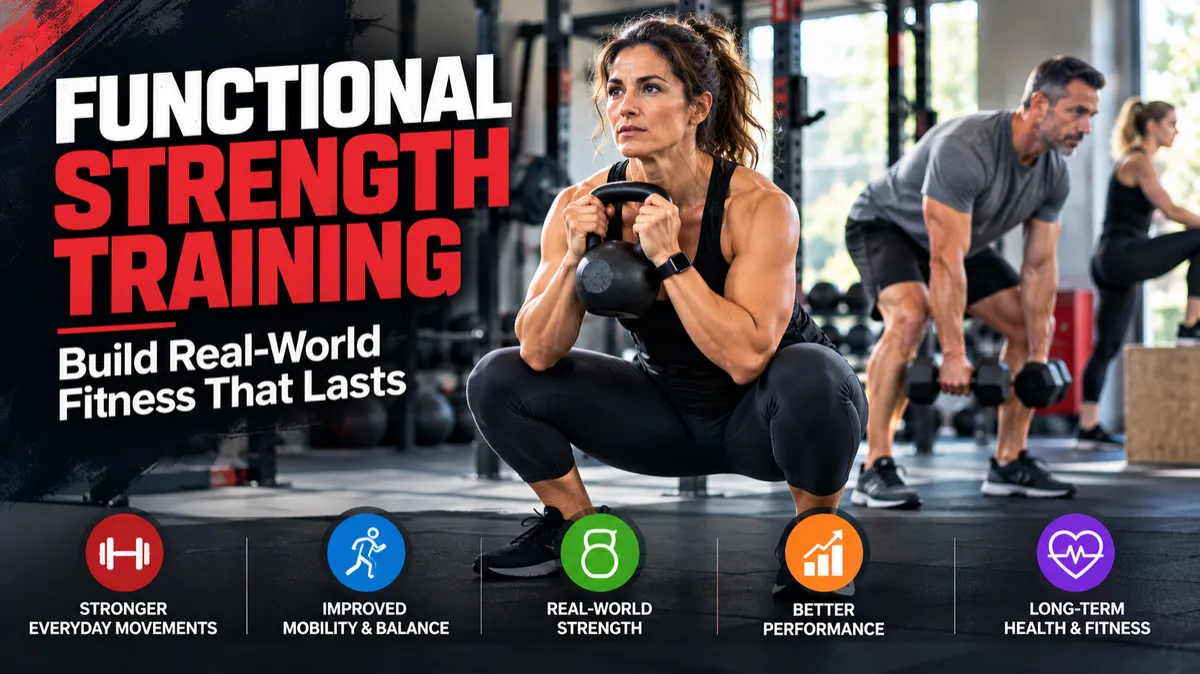
Functional Strength Training: Build Real-World Fitness That Lasts
What if your workouts helped you do more than lift heavier weights at the gym? Imagine carrying groceries with greater ease, climbing stairs without feeling as winded, picking up objects confidently, and moving through everyday activities with better control.
That is the idea behind functional strength training. Instead of focusing exclusively on how much weight you can lift or how your muscles look, this approach develops strength through movement patterns that support the demands of everyday life.
Functional strength training combines exercises such as squatting, hinging, pushing, pulling, carrying, and rotating. These movements challenge multiple muscles and joints while helping you practice coordination, balance, and control. The exercises can be adapted to different fitness levels, goals, and training environments.
For people who want a practical, sustainable approach to fitness, functional training offers a way to connect time spent exercising with the activities that matter outside the gym.
In this guide, we will explore what functional strength training is, how it differs from traditional strength training, which exercises to try, and how to build a routine that supports real-world fitness over time.
What Is Functional Strength Training?
Functional strength training is a form of resistance exercise that develops strength through movement patterns used in everyday activities and sports. Rather than training muscles only in isolation, it often combines multiple muscle groups to improve practical strength, coordination, balance, and movement control.
Think about the physical demands of a normal day. You bend down to pick something up, carry bags from your car, reach overhead to put an item away, or push open a heavy door. Each activity requires a combination of strength, stability, and coordination.
Functional training prepares your body for these demands by practicing similar movement patterns in a controlled environment.
Common functional movement patterns include:
Squatting: Sitting down and standing up, or lowering your body to reach an object.
Hip hinging: Bending to pick something up while controlling movement through your hips.
Pushing: Moving an object away from your body.
Pulling: Bringing an object toward you.
Carrying: Moving while holding groceries, equipment, or other objects.
Rotating and stabilizing: Controlling your torso while turning, reaching, or changing direction.
The exact exercises depend on the person. Someone who wants to keep up with recreational sports may have different training priorities from someone who wants to improve daily mobility or return to exercise after an extended break.
The goal is to develop strength that supports the activities you value.
Why Does Functional Strength Training Matter?
Strength is useful beyond the gym. It contributes to how you move, work, participate in sports, and handle routine physical demands.
A well-designed strength program can improve muscle strength, physical function, and performance on activities such as walking and balance tasks. Research summarized in the American College of Sports Medicine's 2026 position stand supports progressive resistance training as an effective way to improve strength and several measures of physical performance.
Here are several reasons to consider incorporating functional exercises into your fitness routine.
1. Make Everyday Movements Easier
Daily activities often involve several muscle groups working together.
Getting up from a low chair requires lower-body strength and coordination. Carrying a full laundry basket involves grip strength, trunk control, and the ability to walk while holding a load.
Functional exercises practice these combinations.
For example, chair squats can help you develop the movement pattern needed to sit and stand. Farmer's carries, performed while holding suitable weights at your sides, challenge grip strength and the ability to maintain a stable posture while walking.
As your capacity improves, everyday activities may feel more manageable. Actual results vary according to your starting point and training consistency.
2. Develop Strength and Maintain Muscle
Muscle strength supports physical independence and athletic performance. Resistance training can improve or maintain muscle mass and strength, and it remains valuable as adults age.
Functional training can contribute to these benefits by using resistance exercises that challenge the major muscle groups.
Movements such as squats, rows, presses, and hip hinges can be progressed over time by adjusting resistance, repetitions, range of motion, or exercise difficulty.
You do not need to perform complicated exercises to become stronger. Consistent training with suitable resistance and good technique provides a foundation for progress.
3. Improve Coordination, Balance, and Control
Strength is only one part of movement. Your body also needs to coordinate different muscles and maintain control as you change positions.
Exercises such as supported single-leg movements, step-ups, and controlled carries can challenge stability alongside strength.
These skills may be useful when navigating stairs, changing direction during recreational sports, or moving across uneven surfaces.
Balance exercises should match your current ability. Beginners may benefit from a stable support and simple movements before progressing to more challenging variations.
4. Support Long-Term Physical Function
A training program that develops strength, balance, and movement control can help you maintain the capacity to perform everyday tasks as your needs change.
Functional exercise is particularly relevant for people who want to remain active over time rather than focus only on short-term performance goals.
However, no exercise program can guarantee injury prevention or eliminate the effects of aging. Training should be considered one part of a broader approach to physical health, alongside appropriate recovery, nutrition, and general activity.
5. Make Training Relevant to Your Personal Goals
Functional training does not have to look the same for everyone.
A recreational cyclist may prioritize single-leg strength, hip stability, and upper-body endurance. A busy professional may want a balanced program that develops full-body strength in a limited amount of time. Someone returning to fitness may need simpler exercises and a gradual progression.
The benefit of a functional approach is that exercises can be selected according to the movements and physical demands that matter most to you.
Functional Strength Training vs. Traditional Strength Training
Functional and traditional strength training are not opposing methods. Both can build strength and muscle, and many effective programs combine them.
The main difference is often the emphasis placed on exercise selection and training goals.
Feature | Functional strength training | Traditional strength training |
Primary emphasis | Practical movement patterns and physical tasks | Building strength and muscle through resistance exercises |
Typical exercises | Squats, carries, step-ups, hinges, presses | Squats, presses, curls, rows, machine exercises |
Muscle involvement | Often combines multiple muscle groups | May use compound movements or isolate particular muscles |
Main goal | Support everyday movement and activity-specific performance | Develop muscular strength, size, or endurance |
Best approach | Match exercises to real-world needs | Match exercises to the desired strength outcome |
A barbell squat can be part of both approaches. In one program, it may primarily support strength development. In another, it may be combined with carrying, stepping, and balance work to address broader movement goals.
Neither approach is automatically superior in every situation. The right combination depends on your goals, training experience, and physical needs.
7 Functional Strength Exercises to Build Real-World Fitness
You can develop functional strength with body weight, resistance bands, dumbbells, kettlebells, or other suitable equipment.
Start with movements you can perform comfortably and control throughout the exercise. Technique and appropriate progression matter more than making a workout look advanced.
1. Squats or chair squats
Squats develop lower-body strength through a movement pattern used when sitting, standing, and lowering yourself toward the floor.
How to begin: Stand with your feet about shoulder-width apart. Bend your hips and knees to a comfortable depth, then return to standing. Use a chair as a depth target or support if needed.
2. Hip hinges
Hip-hinge exercises train the muscles involved in bending and lifting.
How to begin: Practice moving your hips backward while keeping your spine in a comfortable, controlled position. Once the pattern feels familiar, you may progress to light dumbbells if appropriate.
3. Resistance-band or cable rows
Rows strengthen the upper back and arms through a pulling movement that appears in many daily and recreational activities.
How to begin: Pull the handle or band toward your torso while keeping your shoulders controlled. Return slowly without jerking the resistance.
4. Incline push-ups
Push-ups develop upper-body strength and require you to control your torso while pushing.
How to begin: Place your hands on a stable, elevated surface. Lower your chest toward it and push back up while maintaining a comfortable body position.
5. Farmer's carries
Carries challenge grip strength and your ability to maintain posture while moving with a load.
How to begin: Hold a manageable weight in each hand, stand tall, and walk a short distance with controlled steps. Use clear space and avoid weights that compromise your posture.
6. Step-ups
Step-ups train the legs through a movement similar to climbing stairs.
How to begin: Use a low, stable step. Place one foot fully on the surface, step up with control, and return to the starting position. Use support if needed.
7. Bird dogs
This controlled floor exercise challenges trunk stability and coordination.
How to begin: Start on your hands and knees. Extend one arm and the opposite leg only as far as you can maintain control, then switch sides. Keep the movement slow and comfortable.
These exercises are examples, not a mandatory checklist. Select movements appropriate for your abilities, and ask a qualified fitness professional for modifications if you have pain, mobility limitations, or a history of injury.
How to Build a Functional Strength Training Routine
A good workout does not need dozens of exercises. Start with a few fundamental movement patterns and build a routine you can perform consistently.
For many healthy adults, strength training at least twice per week is a useful general target. The American College of Sports Medicine recommends progressive resistance training that engages the major muscle groups, with the exact program adapted to individual goals and abilities.
Here is a sample weekly structure.
Day | Training focus | Example activities |
Monday | Full-body strength | Squats, rows, incline push-ups, carries |
Tuesday | Light activity | Walking and comfortable mobility work |
Wednesday | Full-body strength | Hip hinges, step-ups, rows, core stability |
Thursday | Recovery | Rest or gentle recreational movement |
Friday | Optional conditioning | Walking, cycling, or suitable sport-specific drills |
Saturday | Enjoyable activity | Hiking, recreational sports, or a longer walk |
Sunday | Recovery | Rest and plan the coming week |
This is an example rather than a fixed prescription. Your ideal schedule will depend on your experience, training intensity, recovery, and other physical activities.
How Many Sets and Repetitions Should You Do?
If you are new to functional strength training, start with a manageable workload.
For example, you might perform one or two sets of 8–12 controlled repetitions for several exercises, using resistance that allows you to maintain good technique. Carries can be performed for short distances or durations.
Adjust the workload if an exercise feels too difficult or too easy. The goal is to challenge your muscles without sacrificing control.
As your fitness improves, you can gradually increase resistance, repetitions, or sets. You do not need to increase every variable at once.
How to Progress Without Overcomplicating Your Workouts
Progressive training means gradually adjusting the demands placed on your body as your capacity improves.
There are several ways to progress:
Increase resistance: Use a slightly heavier weight when your current load becomes manageable.
Improve technique: Perform the same exercise with greater control and a comfortable range of motion.
Add repetitions: Complete a few additional repetitions while maintaining good form.
Increase movement difficulty: Progress from a supported variation to a more demanding version when appropriate.
Improve coordination: Practice more controlled movement before adding speed or complexity.
You do not have to make every workout harder than the previous one. Consistent training, adequate recovery, and adjustments based on your response are more useful than constant increases in difficulty.
If you experience persistent pain, unusual fatigue, or declining performance, reassess your workload rather than pushing through.
Common Functional Training Mistakes to Avoid
Functional training can be useful, but its benefits depend on how you apply it.
Choosing complexity over control
Standing on unstable surfaces while lifting weights or combining several difficult movements may look impressive, but complexity does not automatically make an exercise more effective.
Master basic movement patterns first. Add complexity only when it serves a specific goal and you can perform the exercise safely.
Ignoring progressive overload
Repeating the same easy workout indefinitely may not provide enough stimulus for continued strength development.
Once an exercise becomes comfortable, consider making a small, appropriate adjustment to resistance, repetitions, or overall workload.
Neglecting recovery
Your muscles and other tissues need time to adapt to training. Avoid treating every session as a maximum-effort workout.
Include rest days, get adequate sleep, and adjust your routine when necessary.
Copying someone else's program
A workout designed for an experienced athlete may not suit a beginner or someone returning after an injury.
Your program should reflect your starting point, goals, physical limitations, and available time.
Measuring success only by appearance
Changes in body composition can be one goal, but functional training also aims to improve strength and physical performance.
Notice whether you can carry heavier loads with control, perform more repetitions, or complete familiar activities with greater ease.
Who Can Benefit From Functional Strength Training?
Functional strength training can be adapted for a wide range of people, including beginners, busy adults, recreational athletes, and people interested in maintaining physical independence as they age.
It can also be incorporated into sport-specific conditioning or a carefully planned return to exercise after an injury. However, rehabilitation needs may require guidance from a physical therapist or another qualified healthcare professional.
The most appropriate training approach depends on what you want to accomplish.
For example:
Beginners may benefit from basic movement patterns and gradual progression.
Busy professionals may prefer efficient full-body workouts that fit into a limited schedule.
Recreational athletes may need exercises that support the demands of their sport.
Adults focused on long-term health may prioritize strength, balance, mobility, and sustainable exercise habits.
People returning after an injury may need individualized modifications and appropriate clinical guidance.
Functional training is not a single standardized workout. It is an approach to selecting and progressing exercises according to the physical tasks you want to perform.
How Functional Integrated Training Can Help
Building strength is easier when your program reflects your goals, abilities, and training experience.
Functional Integrated Training (FIT), based in Fitchburg, Wisconsin, offers personalized training, small-group fitness classes, and strength and performance coaching. Its approach emphasizes tailored workouts, coach guidance, appropriate exercise modifications, and accountability.
If you are unsure where to begin, the team offers an initial discovery call and an in-person evaluation to discuss your goals, assess your starting point, and identify an appropriate training direction.
You can explore these resources to learn more:
Personal Training at Functional Integrated Training — for individualized coaching and training plans.
Small Group Training — for coached workouts with a supportive group environment.
FIT Training Programs — to compare available training options.
Strength Training Blog — for more fitness and strength-related educational content.
The advantage of working with a coach is not simply having someone choose exercises. A good coach can help you learn proper technique, adjust training demands, monitor progress, and stay accountable to a routine that fits your circumstances.
Frequently Asked Questions About Functional Strength Training
1. What is functional strength training?
Functional strength training uses resistance exercises based on movement patterns that support everyday activities and sports. Common examples include squatting, hinging, pushing, pulling, carrying, and stepping. The aim is to develop strength, coordination, and movement control that transfer to practical physical tasks.
2. What are the benefits of functional strength training?
Functional strength training can help improve muscular strength, coordination, balance, and physical function. Depending on the program, it may also support mobility and sport-specific performance. Results depend on exercise selection, training consistency, individual circumstances, and appropriate progression.
3. Is functional strength training suitable for beginners?
Yes. Beginners can start with accessible variations such as chair squats, incline push-ups, light resistance-band rows, and supported step-ups. Exercises should match your current abilities, with difficulty increasing gradually as your technique and fitness improve.
4. How often should I do functional strength training?
Many healthy adults can work toward at least two strength-training sessions per week that cover the major muscle groups. The appropriate frequency depends on training intensity, experience, recovery, and other activities. Beginners may need a lighter starting schedule.
5. Can functional strength training help with everyday activities?
It can help develop the strength and coordination used in tasks such as carrying groceries, getting up from a chair, climbing stairs, and lifting objects. Exercises should reflect your specific needs, and improvements will vary according to your starting point and consistency.
6. Is functional training better than traditional weightlifting?
Neither is universally better. Functional training emphasizes movement patterns and practical physical tasks, while traditional strength training may focus more specifically on strength or muscle development. Both can improve strength, and combining them can be an effective approach.
7. Do I need gym equipment for functional strength training?
No. Many exercises can be performed using body weight, a sturdy chair, or resistance bands. Dumbbells, kettlebells, and gym machines can provide additional resistance as your training progresses. Choose equipment and exercises appropriate for your abilities.
8. Can functional strength training support athletic performance?
Yes. When designed around a sport's demands, functional strength training can help develop strength, coordination, balance, and physical capacity relevant to athletic activities. A sport-specific program should complement rather than replace the technical practice required for that sport.
9. How long does it take to see results from functional strength training?
Progress varies according to your starting fitness, training frequency, exercise selection, recovery, and nutrition. Some people notice improvements in exercise control or endurance before seeing larger changes in strength or body composition. Consistent training over time is essential.
10. How can I get started with Functional Integrated Training?
Visit the Functional Integrated Training website to explore its programs and request an initial discovery call. You can discuss your fitness goals, training experience, and any physical limitations with the team before deciding which option suits you.
Build Strength That Supports Your Life
Functional strength training is about developing the physical capacity to do the things that matter to you. Whether your goal is to carry heavy objects more confidently, improve recreational sports performance, or maintain an active lifestyle, a well-designed strength routine can help you work toward those goals.
Start with fundamental movements, prioritize technique, and progress gradually. Give yourself enough time to recover, measure improvements beyond appearance, and adjust your training as your needs change.
Most importantly, choose a routine you can sustain.
If you want professional guidance as you build your strength and fitness, explore Functional Integrated Training's coaching programs to learn how personalized training and coach support can help you work toward your goals.